PointsBet Fieldnotes Australia
Independent brand guide · Australia
PointsBet in Australia: Sports, Racing, Banking and Account Rules
What the PointsBet betting product contains, how deposits and withdrawals work under Australian payment rules, and which protections come with every account.
PointsBet is an Australian-built bookmaker. In Australia it takes bets on sport and racing through pointsbet.com.au and its iOS and Android apps, with fixed odds, multis and its own Same Game Multi builder at the centre of the product.
The useful questions for an Australian reader are practical ones: what the betting markets contain, how prices and multis combine, how deposits and withdrawals work now that credit cards are banned for online betting, and which protections the national consumer framework attaches to every account. This guide answers each in turn.
- Australian operatorPointsBet Australia Pty Ltd
- Products in AustraliaSports and racing betting
- Bet typesSingles, multis, Same Game Multi, racing exotics
- Deposit methodsDebit card, PayID, Apple Pay, Google Pay, bank transfer
- AccessiOS and Android apps, web browser
Australian law prohibits offering online casino games to people in Australia. PointsBet operates here only as a sports and racing bookmaker, and no PointsBet casino is available to Australian residents; see PointsBet’s licence and Australian law.
Explore the guide
Table of Contents
- The Australian betting product
- How betting sessions create financial exposure
- How prices and multis combine
- What a gambling session can cost
- App and browser access
- Australian banking options by function
- Limits, support and account management
- How the PointsBet brand is organised
- Common questions about PointsBet in Australia
- PointsBet in context
The Australian betting product
PointsBet’s Australian service is a fixed-odds bookmaker. It covers more than 25 sports, with the strongest depth on the competitions Australians bet on most: AFL, NRL, cricket, basketball, soccer, tennis and the major American leagues. Thoroughbred, harness and greyhound racing run alongside sport, with win, place and exotic bet types on Australian and international meetings.
Same Game Multi is one of the product’s signature features. It lets a customer combine several outcomes from one match, such as a winning team, a player’s disposals and a total-points line, into a single bet with one combined price. Standard multis combine legs from different events. Both formats multiply prices, which is exactly why they also multiply the chance of the whole bet losing: every leg has to succeed.
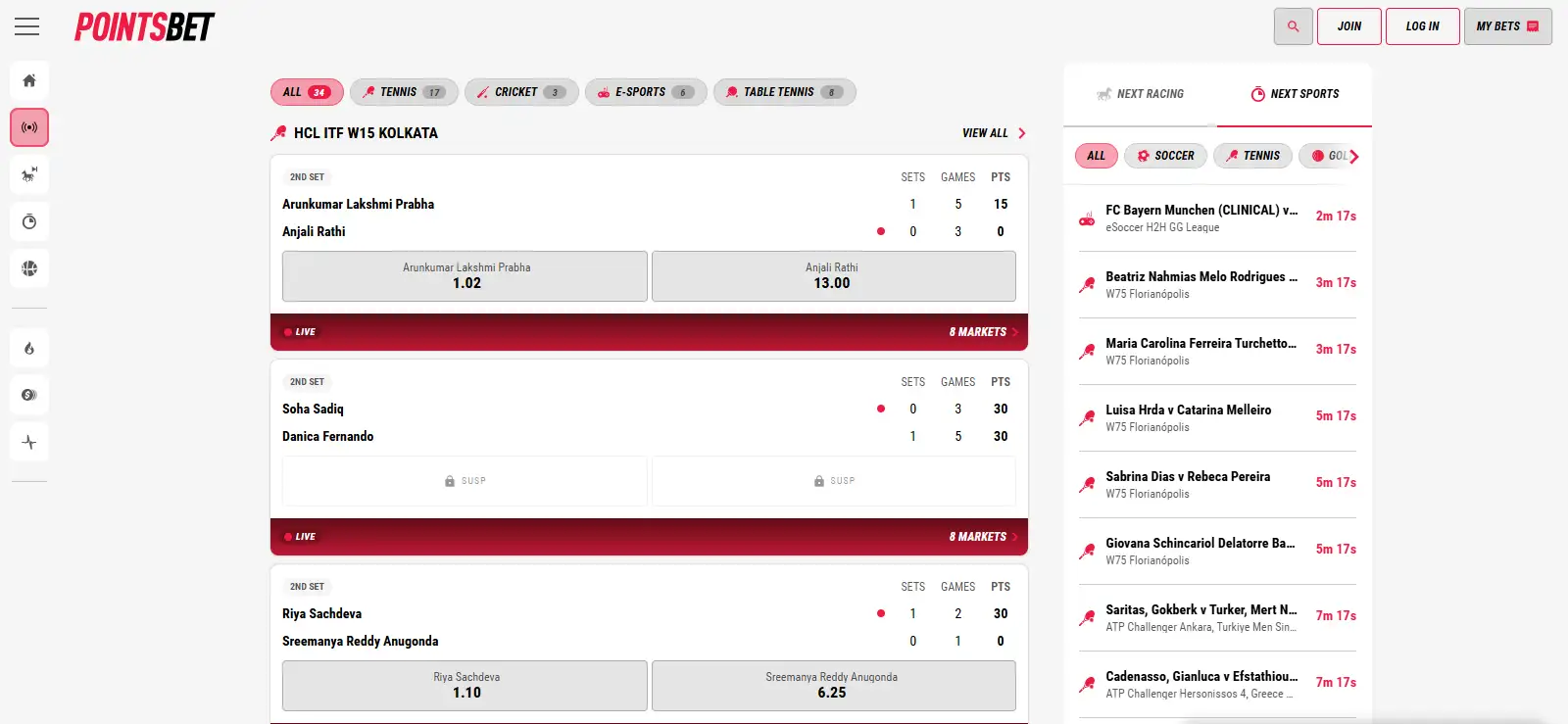
Australian rules also shape when bets can be placed. Under the Interactive Gambling Act, licensed bookmakers cannot accept online bets on a sporting event once it has started, so in-play sports bets are taken by phone rather than through the app. Racing works differently, because each race is a short, separate event, and betting closes when the race jumps.
| Bet type | How it works | What to watch |
|---|---|---|
| Single | One selection at fixed odds | The price is locked when the bet is placed |
| Multi | Several selections from different events | Every leg must win; one loss ends the bet |
| Same Game Multi | Several outcomes from one match | Related legs are priced together, not as independent events |
| Racing exotics | Quinella, trifecta, first four and similar | Higher potential returns come with much lower hit rates |
For market questions
Check the exact market wording: whether a player market includes extra time, how a scratched runner is treated and when a result is settled. The rules page for each sport answers more disputes than any summary.
For money questions
Separate the deposit method from the withdrawal route. A card can fund an account, but winnings go back to a verified bank account, and identity checks come first.
For service questions
Keep dated support messages, bet references and screenshots of account notices together. Specific records resolve a dispute faster than general impressions.
The practical conclusion is that PointsBet in Australia is a betting account with Australian rules attached. The sports and racing guide sets out the markets in detail, and the account and support guide covers the controls that matter when something goes wrong.
How betting sessions create financial exposure
The amount deposited and the amount wagered over a session are different quantities. A balance of A$100 used for twenty A$10 bets, with some winnings reinvested, produces A$200 of turnover. Turnover is the figure that the bookmaker’s margin works on, so it is a better guide to expected cost than the deposit alone.
Every price a bookmaker offers carries a margin. If the true chances of all outcomes in a market add up to 100 per cent, the implied chances in the bookmaker’s prices add up to more, often 105 per cent or higher on head-to-head markets and considerably more on multis and exotics. That margin is not a fee deducted from each bet; it is a long-run average advantage built into the odds.
Volatility changes the shape of the experience
A short-priced favourite wins often and returns little; a long-odds multi rarely wins and returns a lot. Over time both can cost the same on average, yet they feel completely different. A run of losing multis can drain a balance quickly, while a single large collect can encourage bigger stakes afterwards. Neither pattern changes the underlying margin.
Racing adds frequency. A full Saturday card across several states offers a new race every few minutes, which makes it easy to place many more bets than planned. Setting the number of bets, not just the stake, is one of the most effective ways to keep turnover under control.
Why can the expected loss look small while risk remains large?
An expected value is an average calculated across many comparable outcomes. Individual gains and losses fluctuate around it, often widely. Betting the same bankroll repeatedly creates more opportunities for the balance to fall, and the entire available amount can be lost in a short session.
Account-level limits address a different part of the problem. They constrain time or money regardless of the odds on offer. Australian bookmakers must offer deposit limits, and PointsBet’s settings are explained in the guide to player limits and account management. They work best when set before betting starts, not after a loss.
How prices and multis combine
A fixed-odds price is a return, not a probability. Odds of $2.50 return A$2.50 for every A$1 staked if the bet wins, including the stake. The implied chance behind that price is 1 divided by 2.50, or 40 per cent. Comparing that implied chance with a realistic view of the outcome is the core of reading any betting market.
Multis multiply prices. Three legs at $1.80, $2.00 and $1.60 produce combined odds of about $5.76, which looks attractive. The combined chance, however, also multiplies: if each leg were a fair 50 per cent, 50 per cent and 60 per cent proposition, the whole multi would land only about 15 per cent of the time. Every extra leg adds the bookmaker’s margin again, so the long-run cost of a multi is higher than the cost of its legs bet as singles.
| Legs in a multi | Combined odds if each leg is $1.90 | Chance all legs win if each is 50% |
|---|---|---|
| 1 (single) | $1.90 | 50% |
| 2 | about $3.61 | 25% |
| 3 | about $6.86 | 12.5% |
| 4 | about $13.03 | 6.25% |
| 6 | about $47.05 | about 1.6% |
Same Game Multis add a further wrinkle. Outcomes inside one match are often linked: a team that wins comfortably is also more likely to cover a points line, and its best player is more likely to reach a disposal target. PointsBet prices those legs together rather than simply multiplying independent odds, so the displayed SGM price is usually lower than the product of the individual prices. That adjustment is normal and is set out in the bet slip before the bet is confirmed.
The bigger the advertised return on a multi, the smaller the chance of collecting it. A long-odds multi is a low-probability bet, whatever its individual legs look like.
Racing exotics follow the same logic. A trifecta pays well because picking the first three runners in exact order is difficult, and a first four is harder still. Where flexi betting is offered, it lets a customer take a percentage of a combination for a smaller outlay, which reduces cost but not the difficulty of the selection. The sports and racing guide explains the main markets and their settlement rules.
Gambling mathematics
What a gambling session can cost
Explore the theoretical cost of a hypothetical session using your own example stake, number of bets and bookmaker margin or house edge. These inputs are illustrations, not PointsBet odds, margins or limits.
Smaller illustrative exposure. Actual losses can be much higher than this statistical average.
How the illustration works
Amount wagered = stake per bet × number of bets. Theoretical expected loss = amount wagered × example house edge ÷ 100. These are mathematical expectations across many bets, not a forecast for one session.
Random outcomes can depart sharply from the average. A session can end with a gain, a larger loss, or the entire money staked lost. Repeated wagering raises total exposure even when the amount staked per bet stays the same.
18+. Gambling can cause financial harm. You can lose the money you spend. Confidential help in Australia: gamblinghelponline.org.au or 1800 858 858.
App and browser access
PointsBet Australia is used mainly through its mobile apps for iPhone and Android, with the same account also available through a web browser at pointsbet.com.au. All three formats share one balance, one set of limits and one bet history, so a limit set in the app also applies on desktop.
Mobile convenience introduces device-specific considerations. A screen lock, an up-to-date operating system and a unique password protect the account more than any in-app feature. Biometric log-in is convenient, but anyone who can unlock the phone can then reach the betting account.
Notifications deserve the same attention. Promotional push messages and price alerts are designed to bring a customer back into the app. Turning them off in the phone’s settings removes one of the most common prompts for unplanned bets, without affecting account security messages.
What does an app-store rating actually measure?
Its reviewers score their experience with the whole app: navigation, stability, market range, promotions and withdrawals. The combined score is not an audited measure of payout reliability or fairness of prices.
The app and browser guide compares the three formats and lists practical device safeguards. The key point is that every format leads to the same Australian account, with the same rules.
Australian banking options by function
PointsBet Australia accepts deposits by Visa or Mastercard debit card, PayID, Apple Pay, Google Pay and bank transfer. Card, PayID and mobile-wallet deposits usually arrive in the account straight away; a standard bank transfer can take longer. Withdrawals are paid to a verified Australian bank account in the customer’s name.

Two payment types are no longer allowed. Since 11 June 2024, licensed Australian wagering providers have been banned from accepting credit cards, and the same ban covers digital currencies such as Bitcoin. Apple Pay and Google Pay work only when the wallet is linked to a debit card; a wallet linked to a credit card is declined.
- Deposit: the chosen method sends money from the customer’s bank to the betting account, usually in real time.
- Account balance: bets, winnings and any bonus bets are recorded against the account, with bonus bets held separately from withdrawable cash.
- Withdrawal: a request is checked against the verified identity and paid to the nominated bank account, outside the betting app.
The separation matters when tracking spending. A deposit leaves the bank immediately, but a withdrawal depends on the account being verified and the bank account details matching the customer’s name. Mismatched names, a recently changed bank account or an incomplete verification are the most common causes of a delayed payout.
A useful distinction
Bonus bets are not cash. Their stake is usually not returned with winnings, so a A$50 bonus bet at $3.00 returns A$100 if it wins, not A$150.
For a method-by-method breakdown, the deposits and withdrawals guide separates funding routes from payout routes and explains how bank-side gambling blocks interact with each method.
Limits, support and account management
Every licensed Australian bookmaker works under the National Consumer Protection Framework for online wagering. For a PointsBet customer that means identity verification before the account can be used, a prompt to set a deposit limit when the account is opened, monthly activity statements showing wins and losses, and the right to close the account at any time.
Choosing a money limit before betting is different from deciding to stop after an unexpected loss. In a losing session, frustration and the wish to recover losses can override earlier intentions. A deposit limit decided in advance turns that decision into an account rule.
Controls addressing exposure
- Deposit limits cap the money coming in each day, week or month.
- Activity statements show net wins and losses for the month.
- Account closure is available on request at any time.
- BetStop excludes a person from every licensed bookmaker at once.
Separate account issues
- Identity checks concern ownership and age, not spending.
- Support records help reconstruct a dispute.
- Bank details must match the verified name.
- Passwords and device sessions need their own safeguards.
A decrease to a deposit limit applies straight away, while an increase only takes effect after a cooling-off period. That asymmetry is deliberate: it makes it easy to tighten control and harder to loosen it in the heat of the moment.
BetStop, the National Self-Exclusion Register, works across the whole licensed market. A person who registers is excluded from PointsBet and every other licensed online and phone bookmaker for a period they choose, from three months to life, and those bookmakers must not send them marketing.
Anyone feeling pressure to chase losses or extend a session needs help that is independent of the bookmaker. Gambling Help Online is available around the clock at gamblinghelponline.org.au, and the National Gambling Helpline is 1800 858 858. The account controls guide explains PointsBet’s settings and support channels step by step.
How the PointsBet brand is organised
The Australian betting service is run by PointsBet Australia Pty Ltd, part of the PointsBet Holdings group. In September 2025 MIXI Australia, a subsidiary of the Japanese entertainment company MIXI, completed a takeover bid for PointsBet Holdings and became its controlling shareholder with about two-thirds of the voting power.
The group also runs a separate Canadian business in Ontario, with its own company, website, app listings and customer accounts. Content about that business, including its payment methods and product range, does not describe an Australian PointsBet account.
Australian operator
PointsBet Australia Pty Ltd, pointsbet.com.au
Parent group
PointsBet Holdings, controlled by MIXI Australia since September 2025
Australian products
Sports and racing betting, including Same Game Multi
Access formats
Australian iOS and Android apps alongside the website
Payment context
Debit card, PayID, mobile wallets and bank transfer; no credit cards or crypto
Knowing the layers helps when reading anything published under the PointsBet name. An app listing, a promotion or a payment page is only relevant to an Australian customer if it belongs to the Australian service at pointsbet.com.au. Lookalike domains that add a letter or change the ending are not part of the brand.
The ownership change did not alter the rules an Australian account works under. Those come from Australian law and the national framework, which apply to every licensed bookmaker regardless of who owns it. The licence and Australian-law profile sets out that legal position in full.
Read next
- PointsBet’s licence and Australian law
- Deposits and withdrawals in Australia
- Account controls and support
Common questions about PointsBet in Australia
What can you bet on with PointsBet in Australia?
More than 25 sports, including AFL, NRL, cricket, basketball and soccer, plus thoroughbred, harness and greyhound racing, with singles, multis, Same Game Multis and racing exotics.
Which payment methods does PointsBet Australia accept?
Deposits by Visa or Mastercard debit card, PayID, Apple Pay, Google Pay and bank transfer. Withdrawals are paid to a verified Australian bank account. Credit cards and cryptocurrency are not accepted.
Does PointsBet Australia have a mobile app?
Yes. The Australian app is available on the Apple App Store and Google Play, and the same account works through the website at pointsbet.com.au.
PointsBet in context
In Australia, PointsBet is a sports and racing bookmaker with a strong multi and Same Game Multi product, mainstream Australian payment methods and the full set of national account protections: verification before betting, deposit limits, activity statements and BetStop. Its banking reflects the post-2024 rules, with debit cards, PayID and mobile wallets in and bank-account withdrawals out.
The most useful way to read the brand is product by product. Prices carry a margin, multis compound it, and the tools that limit spending only work when they are set in advance. Used with those facts in mind, the guide’s topic pages give a clear picture of what an Australian PointsBet account involves.
Written by the editors at Pointsbet.